1
See your current position
Bring risks, assets, suppliers, controls and framework obligations into one connected view.
Solution
Establish a practical approach to cyber security for your school, connecting risk, compliance, policies and improvement work with clear executive and board reporting.

The problem
You carry the accountability, but fragmented tools make it difficult to know whether the school is improving or merely staying busy.
You deserve a practical way to explain cyber risk—not another enterprise system that creates more administration.
A clearer way forward
Turn frameworks, risks, evidence and improvement work into one clear operating rhythm.
Trusted in education
Apollo Secure works with education industry bodies to ensure we're building the best Edtech solution for Australian schools.


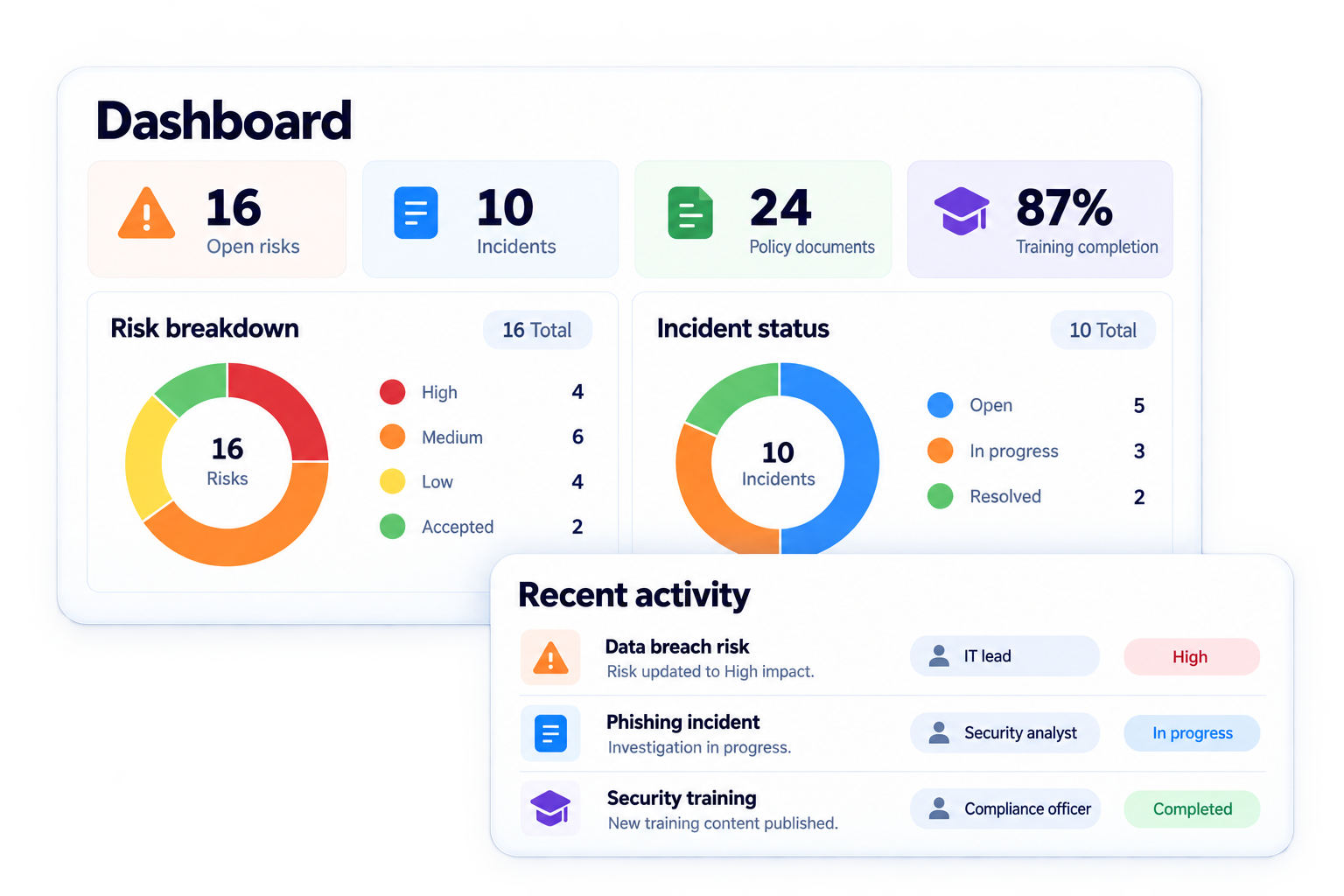
A simple plan
Start from the position you have today and build a repeatable rhythm your team can maintain.
Bring risks, assets, suppliers, controls and framework obligations into one connected view.
Assign practical improvement work according to the risks and gaps that matter most to your school.
Keep evidence current and give executives and the board reporting they can understand.
Connected in Apollo
Apollo connects these capabilities so records, ownership, evidence and reporting remain in one place.
Maintain the risks the organisation manages, with ownership, scoring, treatment and connected context in one current register.
Explore capabilityMaintain the measures used to reduce risk and support compliance requirements, including ownership, implementation and review.
Explore capabilityMaintain the information, systems, services and other resources the organisation depends on.
Explore capabilityMaintain the third parties the organisation relies on, their services, data context, ownership and review status.
Explore capabilityRecord incidents, response activity, decisions, related work and lessons in one governed record.
Explore capabilityBrowse the standards and obligations available to the organisation before adopting a version as active compliance work.
Explore capabilityTurn framework requirements into owned responses, controls, evidence, tasks and measurable outcomes.
Explore capabilityCreate and maintain policy content from files, URLs, templates or Apollo's structured document editor.
Explore capabilitySend policy drafts through independent review, proposed changes and accountable approval before publication.
Explore capabilityAssign published policies to the relevant staff and maintain records of reading, acknowledgement and follow-up.
Explore capabilityAssign, prioritise and track follow-up work.
Explore capability
The outcome
Your team knows what matters next, leaders understand the school’s position and every improvement has a visible owner and history.
Customer proof
Customer stories showing how connected governance, evidence and action create a clearer path forward.
Questions and answers
Practical answers to common questions about managing this responsibility well.
Start by assigning an accountable owner to each material cyber risk, with regular review and a clear path for escalation to leadership or the board. Maintain a current view of important systems, student and staff information, suppliers, credible threats, controls and improvement work.
The IT department may coordinate the security program, but cyber security is an organisational risk that ultimately sits with the school leadership and board.
There is no single framework for every school. Australian schools can use the Essential Eight and SMB1001 as practical technical baselines, then draw on broader frameworks such as NIST CSF or ISO 27001 according to risk and assurance needs.
A board report should show the school's most material cyber risks, changes in exposure, major incidents, control and framework progress, overdue treatment, supplier concerns and decisions requiring board attention.
A school cyber security policy should define responsibilities, acceptable use, access and account protection, information handling, incident reporting, supplier expectations, staff awareness and the process for reviewing exceptions. Supporting procedures should explain how those expectations are carried out in practice.
Establish a regular review cadence, such as monthly IT checks, quarterly committee reviews and an external review every year or two. Also review material cyber risks whenever there is a significant incident, supplier or system change, new threat, control failure or change in obligations. The most exposed risks and overdue treatments should be visible to leadership between formal reviews.
See how Apollo Secure can help your team replace scattered work with a clear, repeatable approach.